Wednesdays at 13:00
Published by Muoi Tran on September 9, 2026
Slightly more than a year ago, I gave a talk to our Network and Systems (NS) unit about my research on routing security. It went well (or at least that was my impression). It brought me closer to the unit, and it put one corner of network security on everyone’s radar. The unit did have seminars before I joined, but from what I heard they were a bit opportunistic, e.g., only when someone is visiting.
So we thought, why not keep meeting, with a fixed time slot and a fixed room, as a standing platform to talk about our research and the technologies we care about? For context, our unit is a wide tent: distributed algorithms, systems and network security, stream processing, machine learning systems, and more. And so NS Meetups was born, running almost every Wednesday at 13:00.
A year and quite a number of Wednesdays later, here is what I learned from running it.
What worked well
Based on a recent feedback form, most people were happy with a fixed one-hour slot right after lunch, mid-week. We were lucky to secure one of the best meeting rooms in the building. The space was tight at times, but I cannot recall anyone having to stand.
The content was varied enough to keep everyone interested. In an average month we ran two sessions sharing interesting papers, articles, and tools, one on work-in-progress projects, and one reserved for a guest talk, a dry run, or simply a break.
Fika came up again and again as an extremely good incentive, especially for a meeting right after lunch. Thanks to our voluntary snack bringers, we essentially did a world tour last year, e.g., Asian sweets, Algerian desserts, and British homemade apple pie.
What could have been better
At the beginning, I proposed that papers be presented as lightning talks: five minutes to present, five minutes for Q&A. That ambitious plan did not work at all, especially since the atmosphere we wanted was casual and open to discussion. On the contrary, we noticed that when a session happened to have only two or three talks, the discussion was much more engaging and everyone was far more relaxed. So in the second half of the academic year, we capped it at three talks per session.
 |
|---|
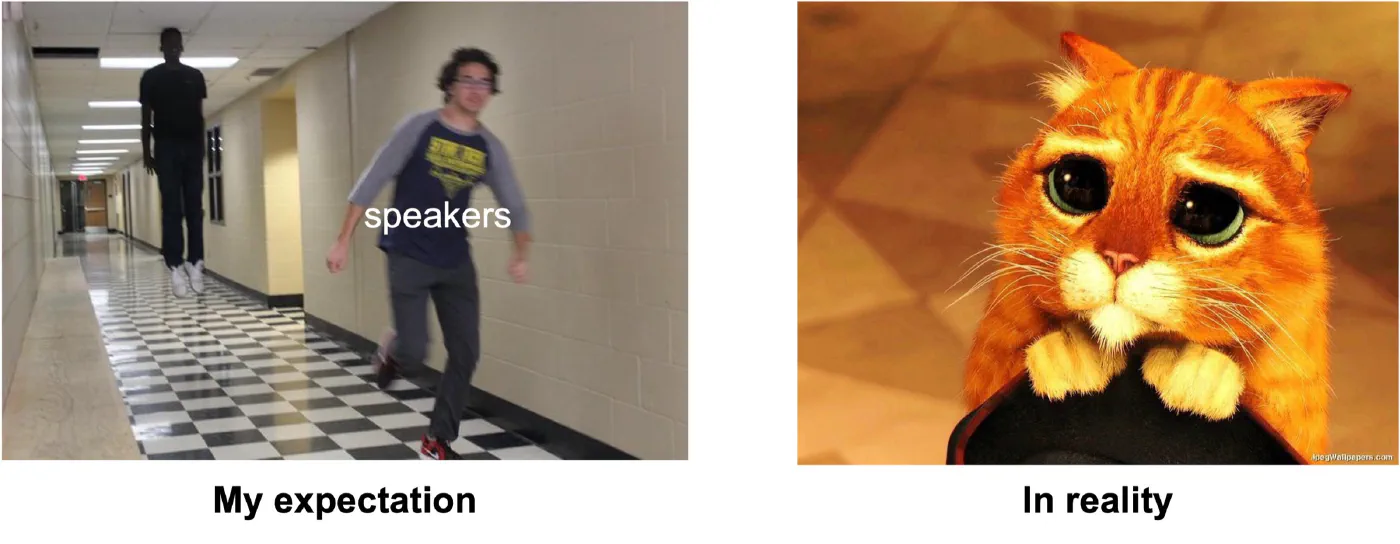
| Figure 2 — Chasing people with busy schedules was much harder than I thought. |
Also at the beginning, when the format was new to many, it was difficult to find speakers. It was very common that I had to go down the list of unit members and reach out to whoever had not yet had a chance to present. Often I could not fill the slots at all, which ironically was a good thing, since it stopped us from cramming five talks into an hour. So after the winter break I simply assigned speakers, at random, for every remaining session of the year. The schedule does not always hold, of course, but it is far easier for the speakers (mostly our PhD students) to arrange a swap between themselves than to volunteer out of thin air.
Last year we focused mostly on awareness, that is, what others in the unit are working on, and what the state of the art in their fields looks like. That was the right first step, since with topics as diverse as ours, people need a shared map before they can spot where their interests overlap. In hindsight, though, I would have started nudging people toward those overlaps sooner. A few co-supervised master’s theses came out of NS Meetups, which makes me think there is more where that came from.
What is next?
This year we want to push harder on collaboration. Two initiatives are already on the way: a brainstorming session for master’s thesis topics, and sessions that deliberately put papers from different topics side by side, so we can look for the bridges between them. When the topics in a room are this diverse, the interesting results tend to come from unexpected combinations!
The other natural expansion is inviting more external speakers. External can mean another unit, another division, another department, or another institution, in Sweden or abroad. Remote talks are easy to arrange, so distance is no longer an excuse.
So, an open invitation. If you are in the unit, come and take a slot. If you are elsewhere at Chalmers or GU, get in touch if you would like to give a talk. Unfinished results, a paper that irritated you, a dry run two weeks before a submission? All welcome, and the unfinished ones usually make the best sessions! It is an informal room and we like visitors.
Above all, we keep doing what already works. Come find us on Wednesdays at 13:00, EDIT 8103, for some great chat and fika!
Author